





In the late 1970s, as unrest spread across Iran and the authority of the Pahlavi regime began to fray, Indian diplomats stationed across the country watched closely with unease. From Tehran to the remote outpost of Zahedan in Sistan and Baluchestan province, their reports to New Delhi captured the early signs of a system under strain – strikes, clerical pressure and a state unable to assert control.
While India maintained a working relationship with Tehran, the Shah’s close ties with the United States and Pakistan had long complicated what might otherwise have been a deeper alliance between the two civilizational partners. Even so, Iran remained a crucial partner.
Before the Islamic Revolution in 1979, India sourced nearly a third of its annual crude oil demand from Iran. For many Indians, it was also a land of opportunity. Professionals found placements through official channels, while poorer migrants, often relying on informal networks, attempted riskier journeys in search of work.
Some of those journeys ended abruptly. In its annual report in 1978, the Indian consulate in Zahedan recorded that 171 Indians who had entered Iran illegally through Afghanistan were deported. “Almost all these Indians…were illiterate unskilled labourers belonging to very poor families,” the consulate noted, adding that they had paid large sums to unscrupulous agents in India who promised better prospects.
Alongside them was another, more settled Indian presence. Doctors and engineers, recruited through government channels, were posted across towns and villages within the consulate’s jurisdiction. The consulate described them as “well satisfied” with their work. “Almost all of them are happy with the condition of services with the Iranian authorities, and the Iranian authorities are also mostly satisfied with their performance,” the consulate said in its report.
Diplomatic reports also shed light on the quieter ways Indians were embedding themselves into Iranian society. Some acquired citizenship after marrying locals, though Hindu men marrying Iranian Muslim women were required to convert to Islam before the wedding. Those who naturalised by birth faced no such requirement.

Despite tightening visa regimes, Indian officials noted that those already living in Iran did not encounter racial discrimination. For the moment, even as the country edged toward upheaval, their lives continued with a degree of normalcy.
But signs of change were hard to ignore. As strikes intensified and state control weakened in places, local clerics began asserting authority. In Zahedan, six Indian-run wine shops were forced to shut, with their owners encouraged to shift to groceries and non-alcoholic beverages.
Expanding cooperation
Despite being aware of the deteriorating situation, Indian diplomats expected the Pahlavi regime to survive, largely due to strong backing from Washington.
A 1979 report from the Indian embassy in Tehran to the Ministry of External Affairs underlined the depth of American influence in Iran. “The United States had one of the largest economic and strategic stakes in Iran,” it said. “It was Iran’s largest supplier of arms and had nearly 25,000 American advisors in almost every important sector of the Iranian Armed Forces and the economy.”
The report noted that US President Jimmy Carter rang in 1978 in Tehran. “It was symbolic that the year started with President and Mrs Carter spending the New Year’s eve dancing at the Niavaran palace and assuring the Shah that there was nowhere else they would rather have brought in the new year,” the report added.
A month later, the Shah visited India and spoke of expanding economic cooperation, even agreeing to assist in the Rajasthan Canal project despite Pakistani objections.
As Iran’s domestic situation worsened over the year, the Morarji Desai government was advised to avoid commenting on its internal politics. “Throughout the long months of turbulence in Iran, starting around June, India scrupulously refrained from any statements that might be construed as interference,” the embassy report noted.
After the Pahlavi regime was overthrown in early 1979, the Indian embassy witnessed the unfolding economic crisis, observing that inflation was “running probably at about 50 per cent”. In its annual report, the embassy wrote, “Being a food deficit country, slowdown of trade with Western countries and the virtual breaking of relations between Iran and the US produced serious dislocation in the supplies of food by the end of the year.”

Xenophobic wave
Indian missions estimated that thousands of undocumented Indian migrants were in Iran at the time. The embassy had to deal with numerous applications for emergency certificates from individuals it believed had overstayed and deliberately destroyed or concealed their passports.
“Following the political turmoil, they turned to the Embassy in large numbers for assistance for repatriation,” the report said. “In addition, the Embassy had to undertake repatriation of Indian workers employed in different projects, particularly the Precision Building Co and Saadi Tiles and Ceramic Co.”
Workers from Iran Cable Co and Highway Construction Co, whose wages had gone unpaid for months, even staged a gherao of the embassy. Diplomatic efforts to resolve the issue with the companies failed, forcing officials to approach Iran’s foreign and labour ministries.
At the same time, the new Islamic Republic reached out to Indian doctors, urging them to stay and requesting more to come.
Although a wave of xenophobia accompanied the upheaval, it was not directed at Indians. Settled Indian communities, such as the Sikhs of Zahedan and Tehran, found that little had changed in their daily lives after the revolution. The embassy maintained close contact with the community to ensure their safety. “No anti-Indian sentiments… came to notice, though anti-foreign sentiments, particularly to persons belonging to Western countries, prevailed,” it noted.
The embassy reported that a “large number” of Indian Zoroastrians had migrated to Iran in the years leading up to the revolution, receiving preferential treatment and encouragement to take up citizenship.
“Zoroastrian girls formed a major portion of the Zoroastrian community and had taken up secretarial jobs of typists, stenographers and secretaries,” the embassy noted. “After the revolution, when the country was declared an Islamic Republic, a perceptible change was noticed in the attitude of the Iranian authorities and the preference accorded earlier to Zoroastrians in the matter of work and residence permits was withdrawn.”
There were even instances of Zoroastrians approaching the embassy to reinstate their Indian citizenship.
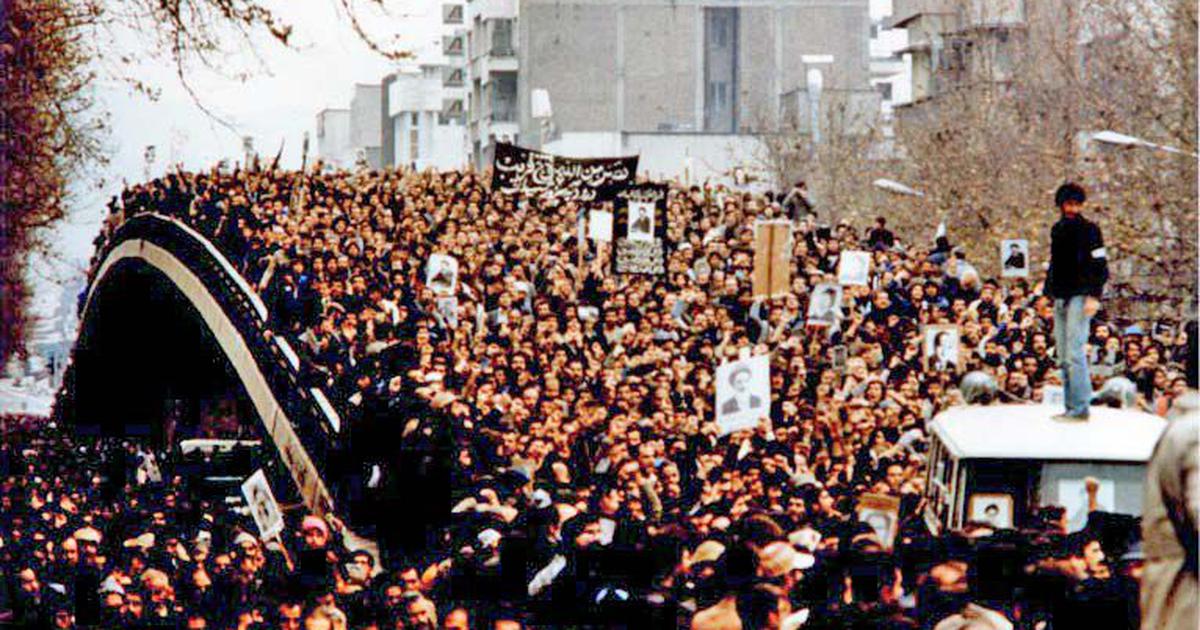
.jpg "A demonstration in Tehran in December 1978. Credit: Bahman Jalali/Wikimedia Commons [Public Domain].")
Revolutionary countries
Once it became clear that the revolutionaries fully controlled Iran, India recognised the new government, becoming the fifth country to do so after Pakistan, Libya, Syria, and the Soviet Union.
“Our messages to [Prime Minister Mehdi] Bazargan and [Supreme Leader Ayatollah] Khomeini spoke warmly about the achievement of democratic rights in Iran and our willingness to cooperate in its economic development,” the embassy’s charge d’affaires GS Iyer wrote to the Ministry of External Affairs in a secret memo dated February 3, 1980.
Iyer noted that relations remained positive due to Iran’s attitude toward the West and its “compulsions” to turn toward India. “Non-aligned Iran shared India’s political and security concerns to a greater degree than the previous regime, and our firmly held secularism made us immune from acrimony generated from religious divisions with Islamic countries,” he added. “More importantly, India was seen as the first and most important example of a country, which had succeeded in becoming truly independent in being able to achieve a greater degree of political and economic self-reliance and freedom from the pressures of the superpowers.”
Tehran’s new leadership began to view India as the “first of revolutionary countries” and sought to build a strong bilateral relationship.
The embassy reported that the number of Iranian students coming to India more than doubled in 1979. “The continued closure of almost all educational institutions in Iran for the major part of the year due to the political disturbances and also because of the unwillingness of the American, British, Canadian and Australian embassies to accommodate Iranian students in their respective countries, there was a marked influx of Iranian students wanting to go to India,” its report said.
There were long queues for student visas, and at times, crowds became unruly, aggressively demanding more visas. “Our appeals to local authorities for protection and security arrangements remained unfruitful,” the report said. “Even when, on a few occasions guards were deputed to do so, they were outnumbered by the visa seekers.” The situation, however, was handled without escalation.
For many students, their time in India was cut short in September 1980, when Iraq invaded Iran and the government recalled around 6,000 students to enlist in the war effort.
Iyer strongly advocated deeper engagement with the Islamic Republic. “The success of the Iranian Revolution certainly produces advantages and opportunities for us,” he wrote in the secret memo. “Iran broke away from the [US-led] regional military groupings and abandoned its claim to be a gendarme of the Gulf.”
He was not particularly concerned about Iran’s religious turn: “Iran’s entry into the non-aligned camp is obviously a positive factor and its stress on militant Islam has not been a negative one because the leadership is conscious that India is home to more than 80 million of their faithfuls.”
As Western sanctions on Iran intensified, Tehran increasingly turned toward India. In June 1980, a 17-member Iranian delegation led by Commerce Minister Reza Sadr visited New Delhi to negotiate a new trade pact.
The resulting agreement, noted the Los Angeles Times, had the potential to soften the impact of sanctions. It called for India to provide Iran with things that it once relied on the West for, such as “grain, drugs and manufactured goods, including steel, automotive spare parts and machine tools, plus technical knowhow”. “While the agreement was confined to Iran’s shopping list, India reportedly received private assurances of guaranteed oil supplies from Iran,” the newspaper said.
The accord helped set the tone for two decades of warm relations between New Delhi and Tehran, generating considerable goodwill for India in Iran. How much of that goodwill survives India’s meek stance on the ongoing US-Israel war on Iran remains an open question.
Ajay Kamalakaran is a writer, primarily based in Mumbai. His latest book, Colombo: Port of Call, has been published by Penguin Random House.
